
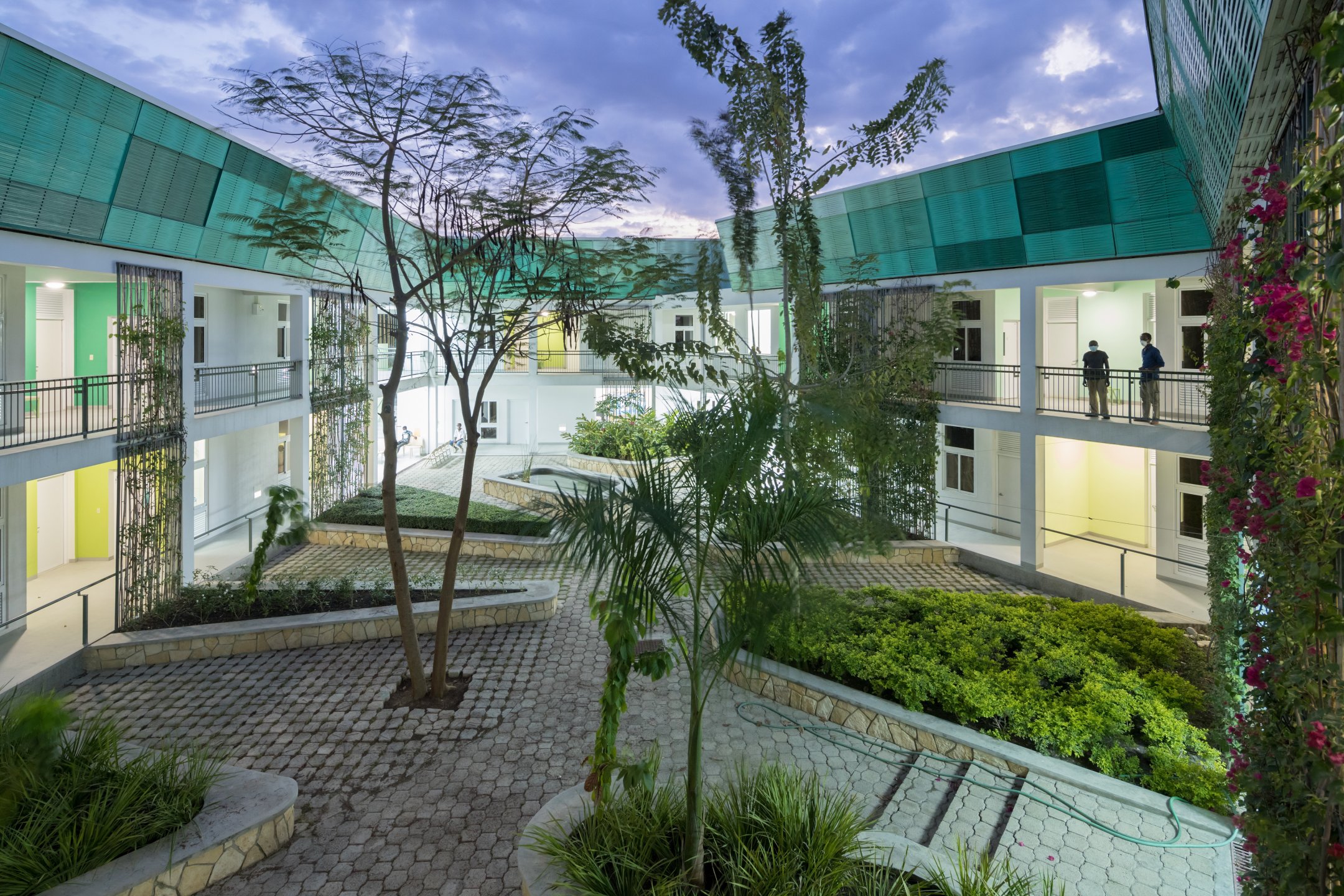
Photo of GHESKIO Tuberculosis Hospital, Photo by Iwan Baan, An Evening image of the inner courtyard

GHESKIO Tuberculosis Hospital

Year
2015
Status
Completed
Size
2,320 sq m
Partners
GHESKIO
Collaborators
GBS Architecture Ltd., CBI, Berelec
Photographer
Iwan Baan
Project Team
Sierra Bainbridge, Karen Conway, Kyle Digby, Robertho Jean Noel, Claire Lubell, Michael Murphy, Alan Ricks, David Saladik, Adam Saltzman, Chris Scovel, Amie Shao
Project Team
Sierra Bainbridge, Karen Conway, Kyle Digby, Robertho Jean Noel, Claire Lubell, Michael Murphy, Alan Ricks, David Saladik, Adam Saltzman, Chris Scovel, Amie Shao
gheskio

The GHESKIO Tuberculosis Hospital in Port-au-Prince offers a dignified and restorative inpatient treatment space that minimizes the risk of airborne transmission.

Haiti has the highest incidence of tuberculosis (TB) in the Western Hemisphere. Tuberculosis is a highly contagious disease that requires treatment of up to 24 months. Patients must be hospitalized in isolation during the first two to six months of treatment to prevent spread. This extended seclusion, paired with severe side effects from treatment medication, can have significant impacts on patients’ mental health. 

GHESKIO

After the 2010 earthquake, the risk of tuberculosis transmission increased because large numbers of people were forced into crowded temporary housing camps. By some estimates, tuberculosis infection rates grew by three times in comparison to pre-2010 levels. And because much of the country’s healthcare infrastructure was badly damaged, many patients either lost access to treatment or were cared for in tents.

Despite these odds, GHESKIO had incredible success treating patients with multidrug-resistant tuberculosis (MDR-TB). Of the first 110 patients treated after the earthquake, 86% were cured or still receiving treatment—a number comparable to the most effective treatment programs worldwide. However, GHESKIO still needed a permanent facility for its tuberculosis patients. 

Learn more

The design of the new tuberculosis hospital focused on minimizing the risk of transmission while creating a more comfortable and supportive space to receive care. The hospital’s central feature is its interior courtyard and adjoining community spaces, where patients spend much of their stay. Flower and tree beds bring color, shade, and seating to the space. Bamboo screens covered in bougainvillea vines create visual privacy for the outdoor consultation spaces adjacent to patient rooms, allowing for conversations between patients and medical staff in the open air where transmission risk is lower.

GHESKIO TB Hospital Cross Section
Gheskio Tuberculosis Hospital
GHESKIO TB Cross Section
GHESKIO TB Patient ward plan

Passive ventilation and infection control strategies help reduce in-hospital TB transmission for this high-risk population while lessening energy costs for the facility. The building controls airborne infection through permeable soffits and metal louvers that pull fresh air throughout the units; and a large double roof provides a buffer from the equatorial sun. All corridors and consultation areas are outside to promote open-air circulation and reduce the risk of patient-to-staff contagion. Cleaning staff can access the restrooms using a separate door from the outside to avoid entering the patient’s room and risking infection. The hospital accommodates 32 patient isolation suites, exam and X-ray rooms, offices, nurse stations, and two pharmacies, setting a new standard for TB care in Haiti.

Photo of GHESKIO Tuberculosis Hospital, Photo by Iwan Baan, Patients socialize in an outdoor area
Gheskio Tuberculosis Hospital
Photo of GHESKIO Tuberculosis Hospital, Photo by Iwan Baan, An evening image of the open-air corridors

GHESKIO’s practice of global health includes the provision of economic opportunities. MASS’s partnership with them prioritized the use of local artisans and crafts wherever possible, while also providing training and capacity building opportunities that benefited the design and community